Free
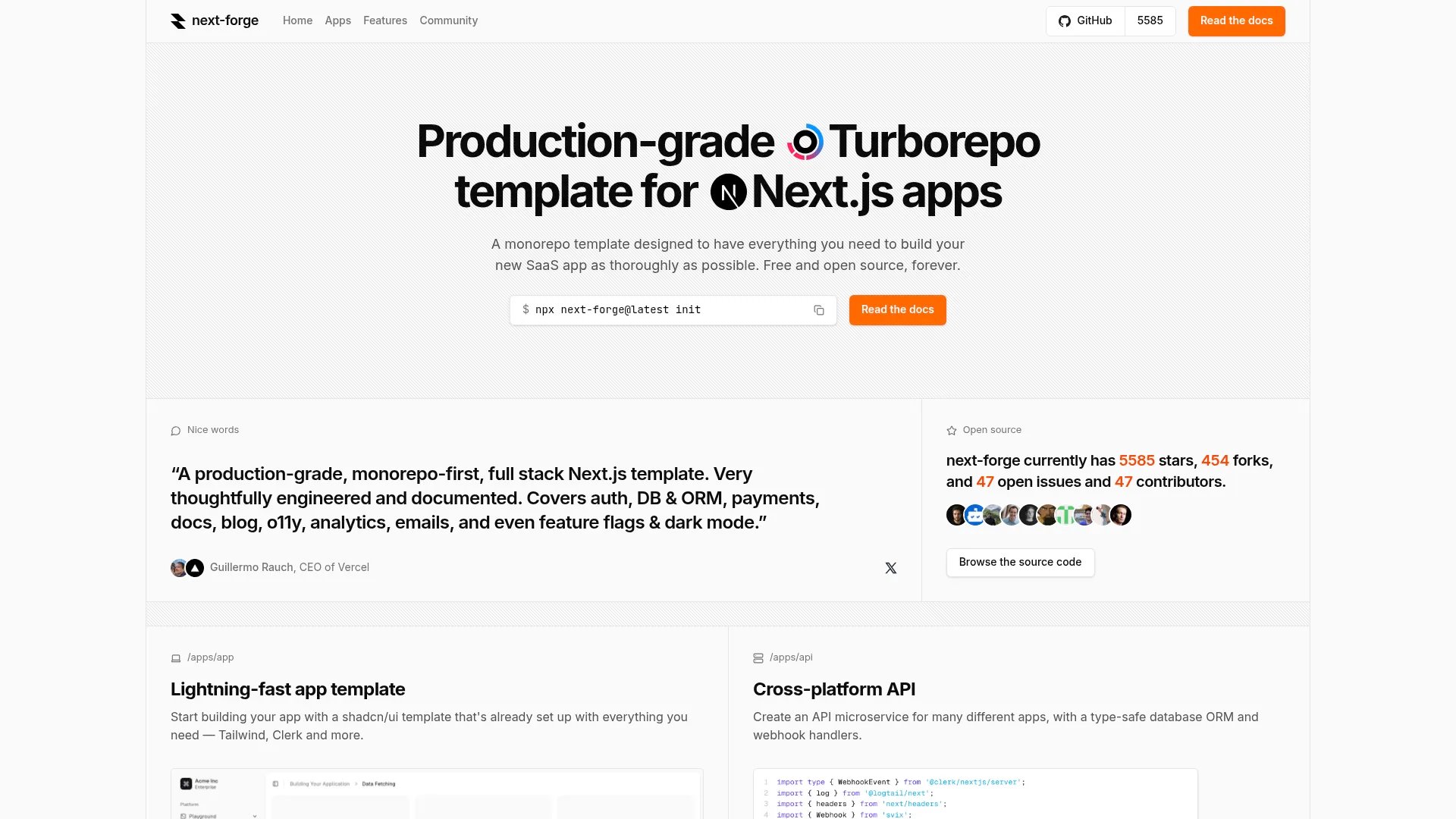
Next Forge
Production-grade Turborepo template for Next.js apps
JavaScript
TypeScript
Radix UI
shadcn/ui
Tailwind CSS
EdgeDB
Neon
Prisma
Turso
Stripe
Next.js
React
Turborepo
Features:
AI
Analytics
API
Auth
Blog
Dark Mode
Docs
+8 more
Explore 1 boilerplate in this collection. Find the perfect starting point for your next project.
Production-grade Turborepo template for Next.js apps
Features:
EdgeDB provides a powerful data storage solution with specific transaction models, indexing strategies, and query capabilities suited for SaaS applications. Our EdgeDB boilerplates implement database-native features—from ACID transactions to advanced indexing—with schemas optimized for EdgeDB's query engine and scaling characteristics.
EdgeDB boilerplates are designed around the database's data modeling approach and transaction semantics. They leverage EdgeDB-specific features like JSONB columns, full-text search, aggregation pipelines, or partition keys depending on the database type. The schema design follows EdgeDB's best practices for normalization (SQL) or document structure (NoSQL), with strategic indexes on query-heavy columns. Migration systems use EdgeDB-native tools for version-controlled schema evolution.
Browse our collection of 1 EdgeDB boilerplate to find the perfect starting point for your next SaaS project. Each boilerplate has been carefully reviewed to ensure quality, security, and production-readiness.
EdgeDB boilerplates utilize the database's native capabilities including its transaction model (ACID for SQL, eventual consistency for NoSQL), indexing strategies (B-tree, GiST, full-text search), and advanced features like JSON columns, array types, window functions, or document queries. The schema design takes advantage of EdgeDB's strengths—whether that's PostgreSQL's JSONB, MySQL's full-text search, MongoDB's aggregation pipeline, or Redis's data structures.
EdgeDB boilerplates include production-tested schemas for multi-tenancy, user management, subscriptions, and billing. The design follows EdgeDB's best practices for data modeling—whether that's normalized tables with foreign keys (SQL), embedded documents vs. references (MongoDB), or partition key strategies (DynamoDB). Schemas include proper constraints, default values, and relationship management optimized for EdgeDB's query engine.
EdgeDB boilerplates implement database-specific query optimizations including strategic indexing on frequently queried columns, query plan analysis, proper use of EdgeDB's query features (prepared statements, query builders, aggregations), and N+1 query prevention. Connection pooling is configured for EdgeDB's optimal settings, and caching layers are positioned to reduce database load while maintaining data consistency.
EdgeDB boilerplates are structured for horizontal and vertical scaling using the database's native scaling features. This includes read replicas, sharding strategies (if applicable), connection pool sizing, and query optimization for distributed systems. The architecture supports EdgeDB's scaling patterns—whether that's PostgreSQL's logical replication, MongoDB's sharding, or DynamoDB's automatic partitioning.
EdgeDB boilerplates include migration systems using database-specific tools (Prisma migrations, Django migrations, Flyway, Liquibase, or native tools). They follow EdgeDB's best practices for zero-downtime deployments, backward-compatible schema changes, and data migrations. Backup strategies leverage EdgeDB's native backup features (pg_dump, mysqldump, mongodump) with automated scheduling and point-in-time recovery configurations.